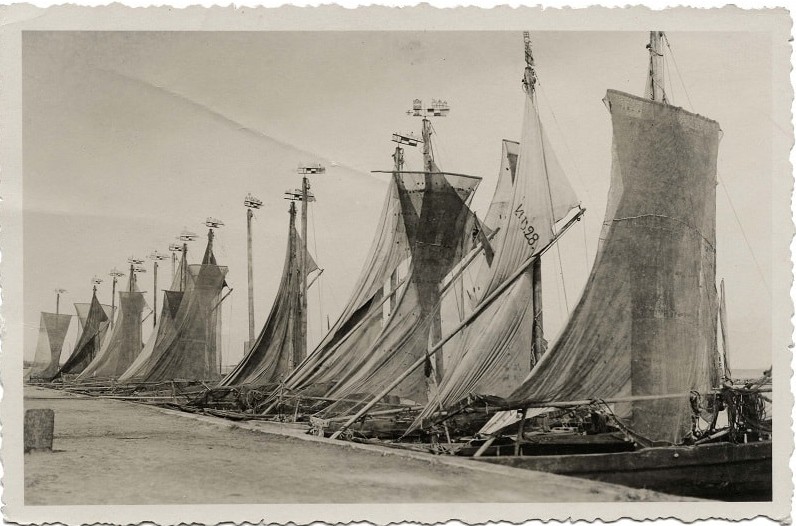
Nidden. Kurenkähne. Photographie A. Hennig. Memel. From Klaipėda County I. Simonaitytė Public Library AdM archive
KNKKA – Archive of Language and Ethnic Culture in Curonian Spit:
Digitization of Sources Artifacts
The Curonian language of the Curonian Spit is classified as an endangered language – with only about ten speakers remaining, all authentic data holds invaluable value for Baltic studies. International concern for the preservation of this language was raised by the scientific community (conference in Portugal "Endangered Languages in Europe", 2013), emphasizing the urgent need to ensure the availability of its sources for research.
The majority of this archive was compiled between 2014–2017 during a project funded by the Research Council of Lithuania (LMT).
Project goals and achievements
The primary goal was to develop and supplement the archive of Curonian language sources, making it suitable for storage and use in digital databases. Currently, the archive consists of:
- Old documents, iconography, cartography, and copies of publications (16th–19th centuries);
- An archive of modern publications;
- Audio and video recordings from various research institutions in Lithuania, Latvia, and Germany, film libraries, and private collections;
- Material from scientific expeditions.
Population lists from the 16th–17th centuries stored in the archive allow for the study of previously undisclosed migration processes and language contacts. Audio recordings, mostly collected from personal researchers' archives, are of particular value. To prevent the loss of unique data, audio and video materials are systematically transcribed using modern technologies to ensure long-term preservation.
Tasks completed:
- Digitization and transcription of recordings from the last decade;
- Preparation of Prof. F. Hinze's manuscript dictionary material (8 volumes of manuscript sheets);
- Selection and archiving of all known historical sources on Curonian language and ethnic culture (texts, studies, maps, iconography);
- Discovery and inclusion of previously unknown historical sources;
- Preparation of archive annotations in Lithuanian and English;
- Publication of the digitized sources catalog.
A joint group of scientists from Lithuania, Latvia, and Germany worked on the creation and processing of the archive.
Project participants and volunteers
prof. dr. Dalia Kiseliūnaitė (Head, Klaipėda University)
Research interests: Baltic linguistics, ethnolinguistics, geolinguistics.
dr. Christiane Schiller (Humboldt University of Berlin)
Research interests: Baltic languages, sociolinguistics, onomastics.
dr. Krišs Kapenieks (Latvian War Museum)
Research interests: History of Baltic nations, history of Latvia.
dr. Dalia Jakulytė (Klaipėda University)
Research interests: Philology, history of language, IT, databases.
Participants: Agnė Vaitiekūnaitė, Monika Valančienė.
Archive staff thanks for volunteering: Gabrielė Abromavičiūtė-Jasiūnienė, dr. Arūnė Arbušauskaitė, Arvydas Barysas, Frederik Bissinger, dr. Eglė Bukantytė, Kęstutis Demereckas, Herta Detzkeit-Paul, Kristina Gibbisch-Venckus, Austris Grasis, Gediminas Gražulevičius, Carl-Christoph Hilgenfeldt, Albina Kotelnikova, Steffen Nebelung, Denisas Nikitenka, dr. Mykolas Letas Palmaitis, Hermann Pietsch, Irena Pflug–Godow, Raimonda Ravaitytė Meyer, Herbert, Werner ir Martin Sakuth, Christel Sakuth–Tepperis, Manfred Schekahn, dr. Roman Shirouchov.
Publications on the topic of the project:
- Schiller Chr., Kiseliūnaitė D. Der nehrungskurische Bogen Nidden im Kontext der litauischen Bögen des nördlichen Memellandes.
- Kapenieks K. Ārpus latviešu tautas palikušie: kursenieku piemērs. Latvijas Nacionālā Vēstures Muzeja Raksti, Rīga, 2017.
- Kiseliūnaitė D. Kuršininkų kalbos ir etninės kultūros duomenų rinkimo ir saugojimo problemos. Tarmės – Europos tautų kultūros paveldas. Mykolo Romerio universitetas, 2015. eISBN9789955197669.
- Schiller Chr., Kiseliūnaitė D. Ein nehrungskurischer Text im Forschungszentrum Deutsche Sprachatlas in Marburg. Das Blatt Nidden 30084. Archivum Lithuanicum. T. 17. 2015. ISSN 1392-737X. P. 443-466.
- Schiller Chr.Kuronismen im Halleschen sog. Richter-Wörterbuch. Res Humanitariae. Vol.15 (2014), pp. 105–114. P. 443-466.
How to use the archive
The digital archive consists of four sections: Publications and Manuscripts, Documents, Photos and Reproductions, and Video and Audio Recordings. You can find documents using the search in the Catalog.
- 🔓 Open access (Level 1): Registered users can view documents directly in the Catalog by clicking the "View" button.
- ⚖️ Copyright protected (Level 2): Documents are available for viewing, but it is mandatory to cite the original source. For publishing rights, please contact the copyright holders directly.
- 🔒 Restricted / Secret access (Levels 3–4): o gain access to documents with copyright or publicity restrictions, you must fill out an order form or contact us via the addresses provided in the Contacts section.